
CEA I-Tésé, the CEA’s institute for research and studies in energy economics, has just published an in-depth analysis of how heat demand is structured across industry. A key topic, because the heat market differs markedly from the electricity market:
- a strong dependence on temperature level, which must be perfectly matched to industrial processes;
- limited transport capacity, requiring a territory-based approach to demand.
This study stands out for the robustness of its scientific approach, in particular thanks to:
- the characterization of 200 TWh of thermal demand based on CEREN 2022 data, drawn from surveys conducted directly with manufacturers;
- the mapping of heat demand municipality by municipality, built from public INSEE data and a Cerema methodology.
Key findings for French industry
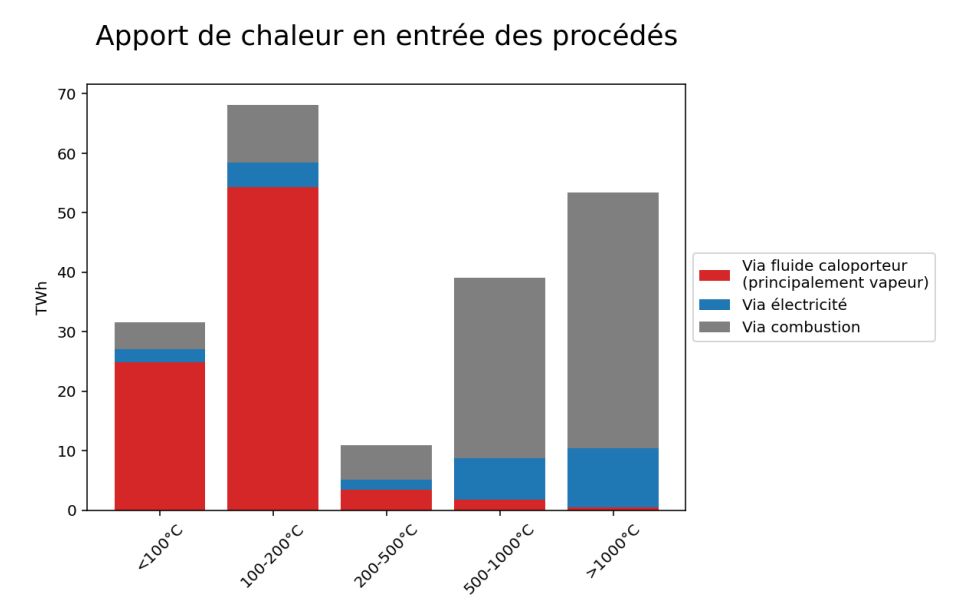
- The 100–200 °C range is by far the most energy-intensive: nearly 70 TWh.
- The 200–500 °C range, by contrast, accounts for only 10 TWh.
Beyond energy consumption, the study also provides essential insight into the challenges of decarbonizing industrial heat. Here again, the 100–200 °C range emerges as the largest CO2 emitter, highlighting a strong dependence on fossil fuels and a strategic energy-sovereignty issue.
By addressing the 100 to 200 °C temperature range, the ARCHEOS reactor is therefore particularly well suited to meet the decarbonization and energy-sovereignty challenges facing French industry.